

Shingle vs. Metal vs. Tile Roofing: Which Is Right for Your Home?
If you're replacing your roof, one of the biggest decisions you'll make is choosing the roofing material. For most homeowners, the conversation eventually comes down to three popular options: asphalt shingles, metal roofing, and tile roofing.
There isn't one material that is automatically right for every house.
Asphalt shingles are generally the most budget-friendly option and offer a familiar appearance with plenty of styles to choose from. Metal roofing costs more upfront, but can provide a much longer service life and a different combination of durability and appearance. Tile roofing is also a long-term option with a distinctive look, but it comes with considerations that make it a different type of investment.
So which one should you choose?
The answer depends on your budget, how long you plan to own the home, the appearance you want, your home's construction, and how much you value long-term service life versus upfront cost.
Here's how the three compare.
Shingle vs. Metal vs. Tile at a Glance
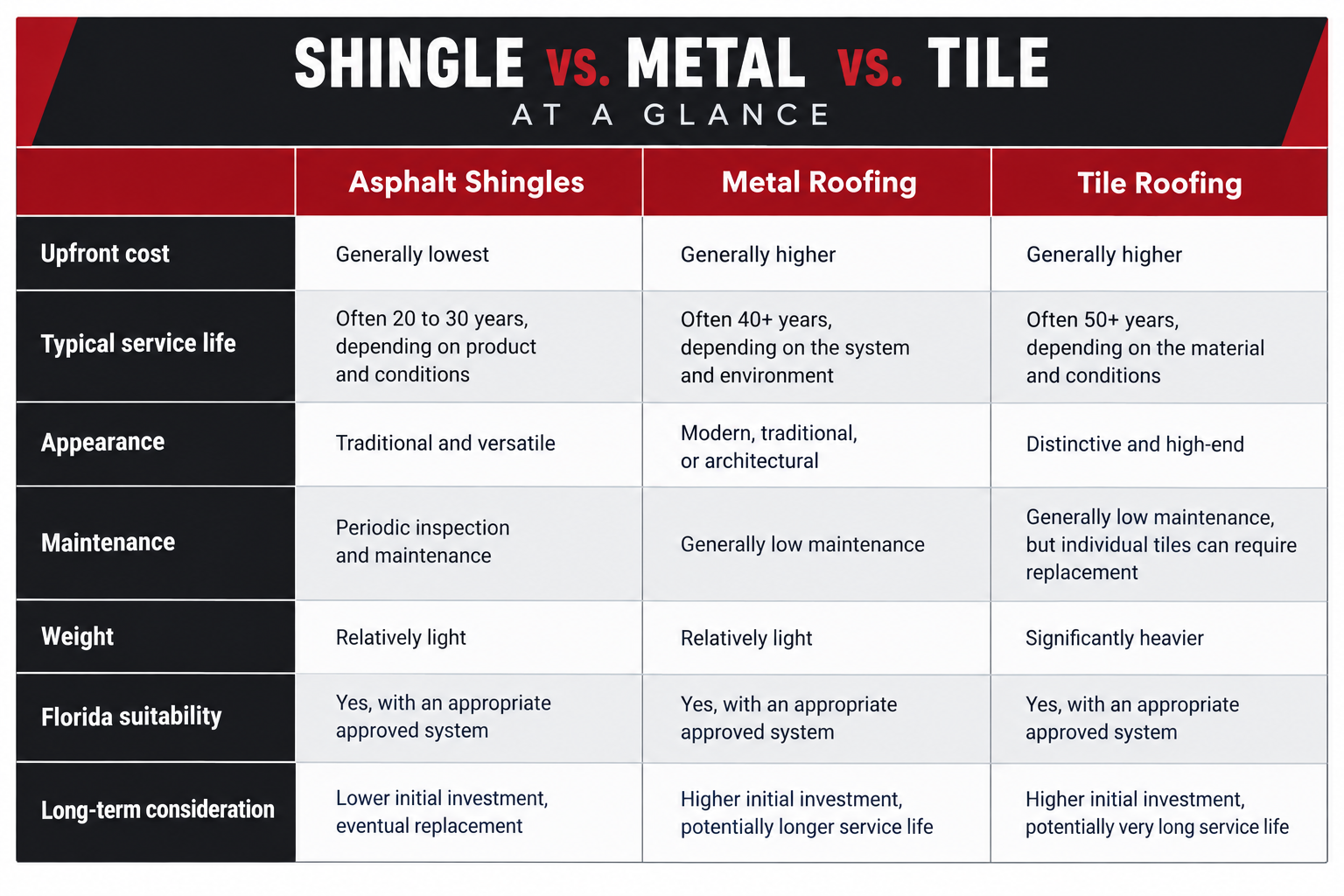
These are general comparisons. Actual performance and service life depend on the specific product, installation, climate exposure, maintenance, and other factors. GAF, for example, gives general residential roofing lifespans of roughly 20 to 30 years for asphalt shingles, 50+ years for metal, and 50 to 100 years for tile.
Asphalt Shingles: The Practical Choice
Asphalt shingles remain one of the most common residential roofing materials in the United States, and there's a reason homeowners continue to choose them.
They're relatively straightforward, widely available, and typically have a lower upfront cost than metal or tile.
Modern architectural shingles also offer considerably more variety than the basic shingles many people remember from older homes. Different colors, profiles, and dimensional designs can give a home a completely different appearance without moving into a more expensive roofing system.
Why homeowners choose shingles
Lower upfront cost
For homeowners working within a specific budget, asphalt shingles can make a roof replacement much more attainable than some of the premium alternatives.
Lots of style options
Today's architectural and designer shingles can mimic the appearance of more expensive roofing materials while remaining within the asphalt shingle category.
Easy to repair
Individual damaged shingles can generally be replaced without replacing the entire roof.
Familiar installation and maintenance
Because asphalt shingles are so common, they're widely understood by roofing contractors and building officials.
The tradeoff
The biggest consideration is longevity.
Even a quality shingle roof is generally going to have a shorter service life than a properly installed metal or tile roof. That doesn't make shingles a bad choice. It simply means the homeowner needs to think about the entire ownership period.
If you're planning to sell the house in a few years, the economics can look very different than they do for someone planning to stay for the next 30 years.
Metal Roofing: Paying More Up Front for Longevity
Metal roofing has become increasingly popular with homeowners who want something beyond a traditional shingle roof.
A properly designed and installed metal roof can provide decades of service, and metal systems can be manufactured in a wide variety of profiles and finishes.
Standing seam metal, exposed-fastener panels, and metal roofing designed to resemble other materials are all available, depending on the home and the system being used.
The Metal Construction Association cites service lives of roughly 40 to 70 years for metal roofing systems, depending on the system and conditions.
Why homeowners choose metal
Long service life
This is one of the biggest reasons homeowners consider metal.
If you're planning to stay in your home for decades, replacing the roof once instead of potentially going through multiple roof replacement cycles can be an important consideration.
Durability
Metal roofing can provide excellent resistance to many of the weather conditions roofs experience, provided the system is properly designed and installed.
Low maintenance
Metal roofing generally does not require the same type of routine maintenance associated with some other roofing materials, although no roof is completely maintenance-free.
Appearance
Metal is no longer limited to the stereotypical image of a shiny metal barn roof.
Modern residential metal roofing is available in numerous colors, profiles, and finishes. Some systems are designed specifically to complement residential architecture.
The tradeoff
The biggest downside for many homeowners is the upfront cost.
Metal roofing generally requires a larger initial investment than asphalt shingles. That means you have to look beyond the price of the first installation and consider how long you expect to own the home.
Metal also isn't simply "better" because it's metal.
The particular panel, coating, fastening method, roof design, installation method, and Florida product approval all matter.
Florida maintains a product approval system that allows contractors and homeowners to verify whether specific roofing products and assemblies have been approved for particular applications.
Tile Roofing: Long-Term Durability and Distinctive Appearance
Tile is a different category altogether.
Concrete and clay tile can give a home a completely different architectural appearance, and properly installed tile systems can have very long service lives.
The Tile Roofing Industry Alliance states that clay and concrete tile roofs can last 50 to 100 years or more, depending on the system and conditions.
Tile is particularly common on homes where the architectural style lends itself to the material.
Why homeowners choose tile
Long service life
Tile can potentially outlast both asphalt shingles and many metal roofing systems.
Appearance
For some homeowners, this is the deciding factor.
Tile provides a distinctive look that can complement Mediterranean, Spanish, coastal, traditional, and other architectural styles.
Durability
Clay and concrete tile are highly durable materials and are designed for demanding weather conditions when properly installed.
Low routine maintenance
Tile itself generally requires relatively little routine maintenance, although the roof system still needs periodic inspection.
The tradeoff
The biggest consideration is that tile is heavy.
Before installing tile, the home's existing structure and roof assembly need to be evaluated to make sure the proposed system is appropriate.
Tile can also be more expensive to install, and repairs require some care because walking on tile incorrectly can break individual pieces.
That doesn't mean tile is fragile. It means the material needs to be handled differently than asphalt shingles or metal panels.
Which Roofing Material Costs the Most?
This is where homeowners often want a simple answer, but there isn't one universal price difference.
Roofing prices depend on the size and complexity of the roof, tear-off requirements, decking repairs, access, permits, material selection, labor, flashing, ventilation, and the specific roofing system being installed.
As a general rule, asphalt shingles are typically the lowest-cost option of these three, while metal and tile generally require a larger upfront investment. GAF similarly identifies asphalt shingles as the most affordable of these common residential roofing options in general terms.
The important question isn't necessarily:
"Which roof is cheapest?"
A better question is:
"What am I getting for the additional investment?"
A homeowner who expects to move in five years may look at a roof differently than someone who plans to stay in the house for the next 30 years.
Which Roof Lasts the Longest?
In broad terms, tile can have the longest potential service life, followed by many metal roofing systems, with asphalt shingles generally having a shorter service life.
But there's an important catch.
The material doesn't determine the entire life of the roof.
Installation quality matters.
So do weather exposure, roof design, maintenance, ventilation where applicable, flashing details, underlayment, fasteners, coatings, and the specific manufacturer's requirements.
A premium material installed incorrectly isn't necessarily a better roof than a less expensive material installed correctly.
That's why it's important to compare the entire roofing system, rather than just the material on top.
Which Is Best for Florida Weather?
All three can be appropriate for Florida homes when the correct product and installation system are used.
Florida's roofing requirements are not simply about choosing a material. The Florida Building Code establishes requirements for roof coverings and their installation, and Florida's product approval system includes specific products and assemblies for different applications.
For example, approved asphalt shingle systems exist for both HVHZ and non-HVHZ applications, while metal roofing products also have Florida approvals with specific limitations and design pressures.
In other words, don't choose a roofing material based solely on a statement like "metal is better in hurricanes" or "tile is better in Florida."
The specific roofing system and how it is installed matter.
What About Energy Efficiency?
This is another area where homeowners can get conflicting information.
Metal, tile, and asphalt shingles can all be available in products designed to provide different levels of solar reflectance and thermal performance.
The U.S. Department of Energy notes that "cool roof" options are available across multiple roofing materials, including asphalt shingles, metal, clay tile, and concrete tile.
That means you shouldn't assume that one material automatically makes a house cooler simply because of the material category.
Color, surface characteristics, insulation, attic conditions, roof design, and the specific roofing product all play a role.
Which Roof Looks Best?
This one is completely subjective.
And that's okay.
A modern standing-seam metal roof may look fantastic on one house and completely out of place on another.
The same goes for tile.
Asphalt shingles are often the most visually flexible because they come in so many colors and profiles, while tile and metal can make a stronger architectural statement.
When choosing between materials, look at the whole house, not just a sample.
Consider:
The home's architectural style
Exterior colors
Siding or stucco
Trim
Windows
Garage doors
Roof pitch
Neighborhood appearance
How long you expect to own the home
So Which Roofing Material Should You Choose?
Here's a simple way to think about it.
Choose asphalt shingles if:
Keeping the initial cost down is important
You want a traditional residential appearance
You want a wide range of color and style options
You're comfortable with a shorter service life
You don't necessarily plan to own the home for several decades
Consider metal if:
You plan to stay in the home for a long time
You value a long service life
You're comfortable making a larger upfront investment
You like the appearance of metal roofing
You want a relatively low-maintenance roofing material
Consider tile if:
You want a distinctive architectural appearance
Long-term durability is a major priority
You're comfortable with a larger initial investment
Your home's structure is appropriate for the weight of the system
You plan to stay in the home for many years
The Most Important Question May Not Be the Material
Homeowners sometimes spend hours comparing shingles, metal, and tile without spending enough time comparing the roofing contractors installing them.
That's a mistake.
A roofing material is only one component of the finished roof.
Before signing a contract, ask what specific product is being installed, how it will be installed, what underlayment and flashing systems are included, what warranties apply, and whether the proposed system is approved for your location and application.
Florida's Building Code specifically requires roof coverings to be installed according to applicable code provisions and manufacturer installation instructions.
Two contractors can quote the "same metal roof" or the "same shingles" while providing very different roofing systems.
Make sure you're comparing the complete scope, not just the material name.
Frequently Asked Questions
Is metal roofing better than shingles?
Not automatically. Metal generally offers a longer potential service life and a higher upfront cost, while asphalt shingles generally offer a lower initial investment and a shorter expected service life. The right choice depends on the homeowner's priorities, budget, home, and expected ownership period.
Is tile roofing worth the extra money?
It can be for homeowners who value long service life, appearance, and durability and are comfortable with the higher initial investment. The home's structure and the specific tile system should also be evaluated before making the decision.
Which roofing material lasts the longest?
Tile can have a potential service life of 50 to 100 years or more, while many metal roofing systems can provide 40 to 70 years or more depending on the system and environment. Asphalt shingles generally have a shorter service life, often around 20 to 30 years for many products.
Is metal roofing too hot for Florida?
Not necessarily. Roofing temperature and a home's cooling performance depend on more than the material itself. Color, solar reflectance, insulation, attic conditions, and the specific roofing product all matter. The Department of Energy recognizes cool-roof products across several roofing material categories.
Can any house have a tile roof?
Not necessarily. Tile is considerably heavier than asphalt shingles or many metal roofing systems, so the home's existing structure and proposed roofing assembly need to be evaluated before installation.
Bottom Line
There is no universal winner between shingles, metal, and tile.
For some homeowners, asphalt shingles make the most sense because they provide a practical roof replacement at a lower initial investment.
For others, metal makes sense because they're willing to spend more upfront for a long-lasting roofing system.
And for homeowners who prioritize architectural appearance and very long service life, tile can be an attractive option when the home is properly suited for it.
The best material is the one that fits your home, your budget, your plans for the property, and the type of roofing system that can be properly installed on it.
If you're considering a roof replacement in Central Florida and aren't sure which material makes sense for your home, Lollar Construction can help you evaluate the options and understand the differences before you make a decision.
Lollar Construction LLC
Serving Central Florida
863-320-1594